The Withered Sanctum: Why I Study RPGs Like Lost Civilizations
RPG worlds are more than entertainment products. They are digital civilizations shaped by mythology, identity, ritual, and memory. This is the philosophical foundation of The Withered Sanctum.
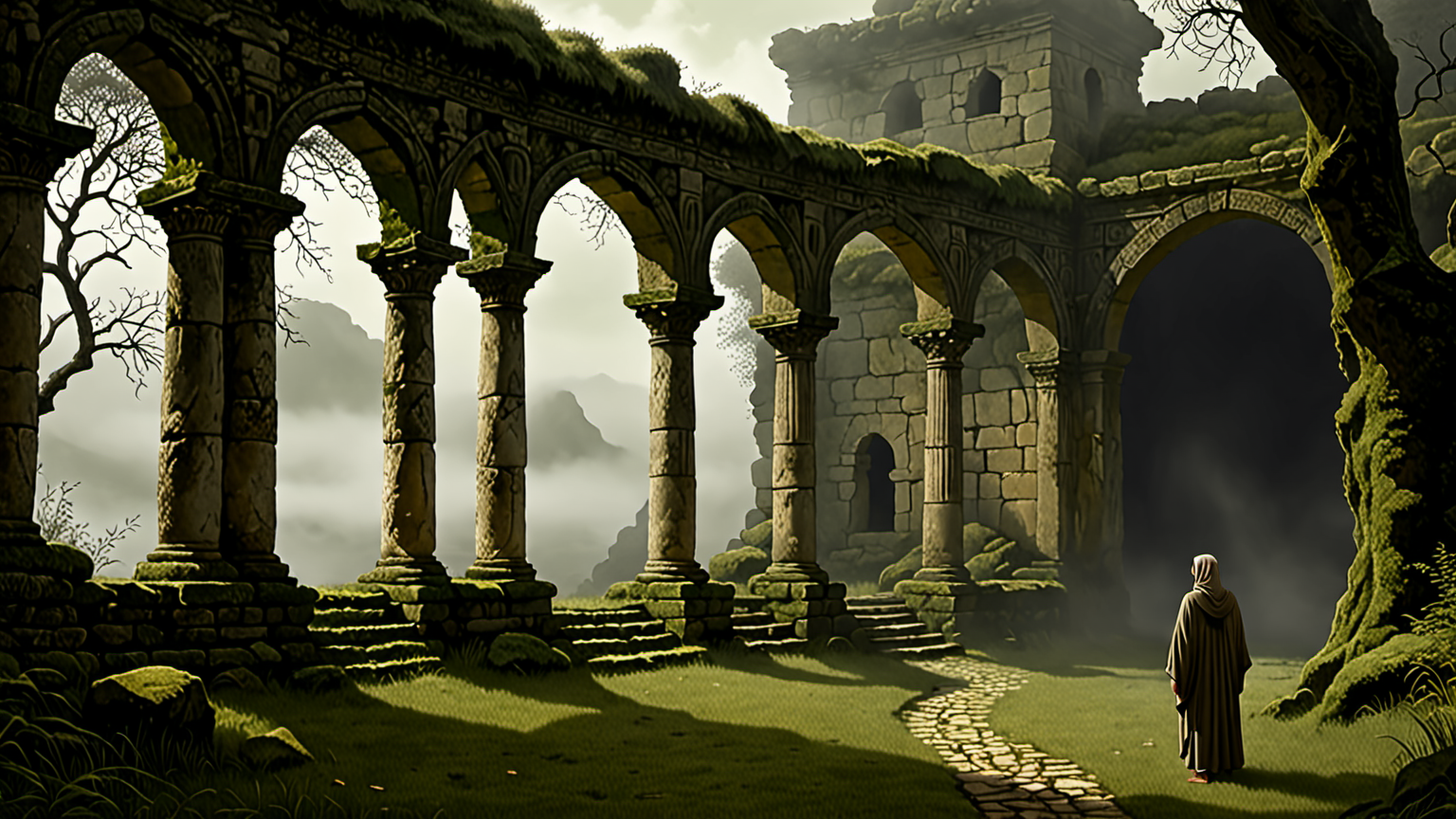
There is a feeling that happens when you truly step out into a new game world.
- Emerging from Helgen into the cold air of Skyrim
- Standing beneath alien skies on your first planet in No Man’s Sky
- Waking alone on the shores of a deserted island in Windrose
- Opening your eyes in a cramped apartment in Night City
It’s that moment when the primary world begins to fade into the background, and you begin seeing through the eyes of your character instead of your own.
It is a sensation that we seek as players of RPGs and open world games. And which drives us to enter into a nearly infinite number of game worlds. But beyond this sensation lies a more important experience, past the sensation of the new, ahead of the promise of potential - the experience of staying.
When the world builders do it right, the world itself forms an invitation and compels you to stay. To spend tens or hundreds of hours in the world, even after you have completed the story of the game or in spite of the story. These are the worlds that behave like civilizations.
It is no mistake that the dragon flies over Bleak Falls Barrow, nor that your companion (Hadvar or Ralof) points out the barrow shortly after. This singular location, sitting high on a mountain, contains all of the elements of civilization, culture, mythology, and meaning. Bleak Falls Barrow is a ruins marked by architecture and prominence. Your companion conveys to you a cultural significance and a mythological belief.
“Bleak Falls Barrow. When I was a boy, that place always used to give me nightmares. Draugr creeping down the mountain to climb through my window at night, that kind of thing. I admit, I still don’t much like the look of it.”
And our first response, as players, is to climb the mountain and get into that ruin. It doesn’t matter that the main quest pushes us to the barrow; how many of us went up that mountain without ever starting the main quest? We did so for many reasons, glory, level progression, loot, epic gear, or epic battles. But in the end we all shared one sensation - we had to know.
These worlds, the ones that are done well, share a common thread. They are rooted in a cultural frame, one that can be experienced and studied with the tools of the humanities. Over time, I began to realize that I was not studying games in the way most players or critics studied them. I was studying them the way an archaeologist studies ruins.
RPG Worlds are Like Digital Civilizations
Some games, and the worlds that live within them, seem to be able to weather the eroding effects of time. They become more than an entertainment product, more than a fleeting experience of mechanics and content that we obsess over until the next game of the year candidate comes along. These are the ones that transcend and often times become a part of our wider cultural experience.
Astonishing as it may be, there are people who have not played Minecraft, yet you would be hard pressed to find a non-gamer who would not recognize the block world, the diamond pick axe, or the Creeper. You would be equally challenged to find a non-gamer who has not heard the phrase “I used to be an adventurer like you…” and not be able to finish the line.
These worlds endure and enter our culture because they themselves contain the persistent elements of civilization. Skyrim’s Nords fear magic and outsiders, yet venerate ancient heroes and sacred burial traditions. Night City treats identity itself as consumable technology. Minecraft strips civilization down to pure construction, survival, and habitation. Over time, we begin to adhere to the social norms and status systems of the game world. The result is that, as players, we begin to live within the structure of the world and our identity both inside and outside that world begins to matter.
Even those worlds that seem to be based on our real world and civilizations, bring with them an interpretation. An interpretation that in turn contains a cultural logic that may be easier for the player to recognize but is vastly different from what it is based on. San Andreas is not California, Night City is not Seattle, Rattay is not Rattay, despite Warhorse’s rigid adherence to history.
The most enduring worlds outlive their intended narratives and allow players to inhabit them in ways that the developers never planned for nor intended. These are the worlds that leave the door open to true role-playing. The worlds that have alternate starts and alternate rulesets that are made up by the players. The ones that behave like real civilizations, creating folk practices, community rituals, and reinterpretation.
Archaeologists study ruins to understand people. I study, and play, RPG worlds for the same reason.
Why the Humanities Matter
The Humanities, as a series of connected disciplines of study, has always been fundamentally about understanding ourselves and our location within a larger culture. It is the study of human meaning: who we are, what we value, what stories define us, what symbols shape us, how we construct identity, and most importantly, how we inhabit our world.
Modern gaming, particularly role-playing, provides the Humanities with two mirroring perspectives. To discover meaning in digital worlds and measure it against the conditions of our own. It lets us begin to answer the aching question: what does the modern world fail to offer that the digital world has provided?
Are the foundations of the digital world, built on the ruins of our physical world?
Archaeology: The Study of Remains
I begin here because my own journey began here. Not because I saw Indiana Jones as a kid and wanted to go on grand adventures (that fantasy was fed by D&D), but because I wanted to be Indiana Jones at the University of Chicago. And so, my earliest classes were on Art History, Latin, the Archaeology of the Biblical world, and the Heritage of Occult Thought.
At its heart, archaeology is not merely the study of ancient societies. It is also the study of loss. The ravages of time, the degradations of war, all have the effect of eliminating the vestiges of civilization and leaving behind a hint. And the challenge is that the hint must be reinterpreted through our own contemporary lens.
We can never know what was actually lost, only speculate as to its nature.
The best game worlds rely on the decay of time to bring life to their worlds. In gaming terms, we talk about environmental story telling, but that is just another term for digital archeology. The Elder Scrolls has long been the model of environmental storytelling. Ayleid and Dwemer ruins speak of a civilization that no longer exists but once was able to construct impressive cities and fortifications that residents of the current age no longer are able.
Players are invited to explore these lost remnants of civilization. To puzzle and debate over the lore. And to find the contradictions in the fragments and lost accounts that are discovered along the way. We are never meant to have the whole picture but instead are meant to form our own conclusions and assumptions along the way.
Anthropology: The Study of Culture
Anthropology is about understanding the ways in which people live within an identifiable group or culture. It explains how people behave and think within a cultural framework that is informed by ritual, scripts, values, identity, and the stories they tell themselves.
Cyberpunk 2077 puts the Anthropology of Night City front and center when it makes you choose a path for your character - Nomad, Streetkid, or Corpo. Each path not only gives the player a different starting episode, it also frames the entire experience of the playthrough. And as a result, forms the basis of the player’s thought and behavior within Night City.
While Night City is representative of Late Stage Corporate Capitalism, each life path deals with the realities of a privatized ecological environment from their own frame. Nomads reject the necessity of cyberware in preference to their vehicles, Streetkids embrace cyberware as status and power, and Corpos use it as a means to achieve more power.
People adapt to corporations the way tribal societies adapt to the climate.
These worlds are shaped by the assumptions, fears, and structures of our own civilization. Yet over time, they also begin shaping how we think, behave, and identify ourselves within the real world. Did you choose Corpo because of who you are, or did becoming a Corpo subtly reshape how you saw yourself?
Not seeing the connection? How many of you have The Vault Dwellers Official Cookbook, The Elder Scrolls Cookbook, or The Hero’s Feast on your bookshelf? Or cosplay on your visit to the local Renaissance Faire. Or have the GTA soundtrack bookmarked in your Spotify?
We do not merely visit these worlds. We carry pieces of them back with us.
Sociology: The Study of Human Behavior
Although I began with Archaeology, Sociology is where I landed. Through a series of serendipitous events, I found myself in a small liberal arts college consuming all of the interconnected humanities through a sociological lens. Not Indiana Jones at the University of Chicago, but close enough for a kid who didn’t own a whip.
It is through this lens that we begin to understand identity. A core feature of most RPGs is that they allow us to create a character in which to inhabit. For many games, the character creation screens are mini RPGs within themselves where a player may spend hours perfecting their own game identity. Yet this is only the beginning. Identity continues to form as you begin to play within a class, join guilds, select arms, armor and costumes, and choose (or not choose) quests to accept and complete.
What does it say about your identity when the game pushes you to play a stealth archer, but you still go the magic route? Swimming against the stream will change how you experience the game and how you will ultimately perceive the game within the frame of your own expectations of identity and culture.
Our frame of identity extends beyond that of our character in a particular game world, but also into our identity in the real world. Playing a game with “no mods”, in survival or hardcore mode, completing platform achievements and publishing hours played all contribute to our sense of identity. And our very human longing to make our identity immortal.
Mordenkainen was just a character and now a legend.
Philosophy: The Study of Meaning
Philosophy, as the discipline that predates all of the others, attempts to bring them together in search of the meaning underlying identity, culture, civilization, and existence itself. RPGs externalize philosophical questions through mechanics, curated storylines, the constructed world, and systems that support it all. Players, on the other hand, live inside that philosophical question.
In Tainted Grail: The Fall of Avalon we begin the game inside one of the most compelling and contemporary philosophical questions:
How much of our humanity are we willing to sacrifice in order to survive?
Your character awakens a victim of the Red Plague who is contained in quarantine. Your character image is not the one you created in the character creation screen, but one that is clearly inflicted with the sores and ravages of this mysterious disease. And like all good RPGs, your first task is to break free, escape from your captors, and learn as much as you can about the situation.
While we blindly followed a familiar RPG trope -the ‘tutorial dungeon’ where we continue our escape under the assumption that the ‘real game’ has not yet started - the tutorial itself establishes the core philosophical frames that will inform the entire playthrough.
- Is it justified to experiment on the sick if it will save all of humanity?
- Is it moral to involuntarily quarantine (e.g., confine) victims who committed no crime except to have the misfortune of contracting a disease?
- Are we the villain for escaping in the first place?
Playing games doesn’t ask you to answer the question consciously, instead you answer the question by how you play the game.
Mythology: The Architecture of Narrative
Also known as, Lore. For many players the mythological narrative of the game is window dressing or distraction from the real work of min/maxing. For others, this is where the soul of the game lives. The roots of all modern RPGs have always been storytelling, and as a result, deeply steeped in myth. The kind that extends back to the campfires of our ancient ancestors.
Myth brings together cultural identity, definitions of meaning, and societal boundaries into coherent lived stories. It is where we find the Norse legacy in Skyrim, Pirate freedom in Windrose, the Fae Realm in Nightingale. Whether consciously or unconsciously, the myth that surrounds the game world communicates to us what the world is about.
After your first mission in Cyberpunk 2077, Jackie Welles lays out the mythology of Night City in a single monologue as you drive home. It is the “City of Dreams” where legends like Morgan Blackhand, Andrew Weyland, and Johnny Silverhand were made. Jackie is telling you, the player, who matters, what success means, what kind of world this is, and what kind of person survives. In short, he is telling you that glory matters more than survival. And ultimately, the game itself sets you up for that reality as the engram will kill you.
The mythology of a world tells players what should matter there. What is heroic. What is forbidden. What survives after death. Long before we understand the mechanics of a game, mythology teaches us how to dream within it.
The Withered Sanctum Itself
Many years ago at 15, when I hadn’t completely formed my own identity, I self-published a TTRPG. I wrote it, organized a play group to test it, begged a friend to illustrate it, designed and typed it, had it printed, registered a copyright, sent a copy to the Library of Congress, and had it stocked at a local game store where it sold a single copy. From my point of view, it is the most successful business I have ever run in my life.
Now, as I have long passed the mid-point in my life, I am looking back with a sense of nostalgia. Not in the sense where I catalogue a list of regrets, but in the way that Tolkien wrote about in On Faerie Stories. As a way of recovery. To connect with some old dreams and to use this moment in my life, and the resources built over years of lived experience, to bring them back and to build a final legacy.
I study games like lost civilizations because I recognize that there are enduring culturally important games that I may learn from. And in so doing, begin work on building a secondary world of my own and revive an old game that has long gathered dust on a shelf in Washington D.C.
I invite you along on this journey. To lurk, to participate, to teach, and to learn. Stories are silent without those who carry them forward, and civilizations fade when no one remains to inhabit them. Whatever Ash of the First Dawn ultimately becomes, it will not belong to me alone.